
Expository Writing: Everything You Need to Know
Expository writing explains and informs through clear, organized facts. Learn its seven main types, how it differs from other styles, and how to craft effective exposition.



Every year, businesses collectively spend billions of dollars trying to teach their employees how to write clearly. Good expository writing requires talent and training, and the limitations of AI-generated content continue to underline the value of cultivating strong writing skills.
Expository writing is one of the most common forms of writing and is used to convey factual information. We encounter it when we learn, and we use it to inform others.
Key takeaways
- Expository writing is factual and informative.
- Its main styles include: definition, process, cause-and-effect, problem-and-solution, comparison, classification, and timelines.
- Writing exposition requires solid research and the presentation of clearly organized facts to inform the reader.
- Craft strong expository writing by conducting thorough research, organizing facts into a coherent presentation, and tailoring the delivery to the intended audience.
What is Expository Writing?
Expository writing aims to expose. It reveals facts about its topic by presenting information in a clear and organized manner. This style of writing is straightforward; it does not seek to engage the reader’s emotions or experiences, it doesn’t weave together complex concepts that need to be interpreted, and it doesn’t urge its reader to agree with its perspective.
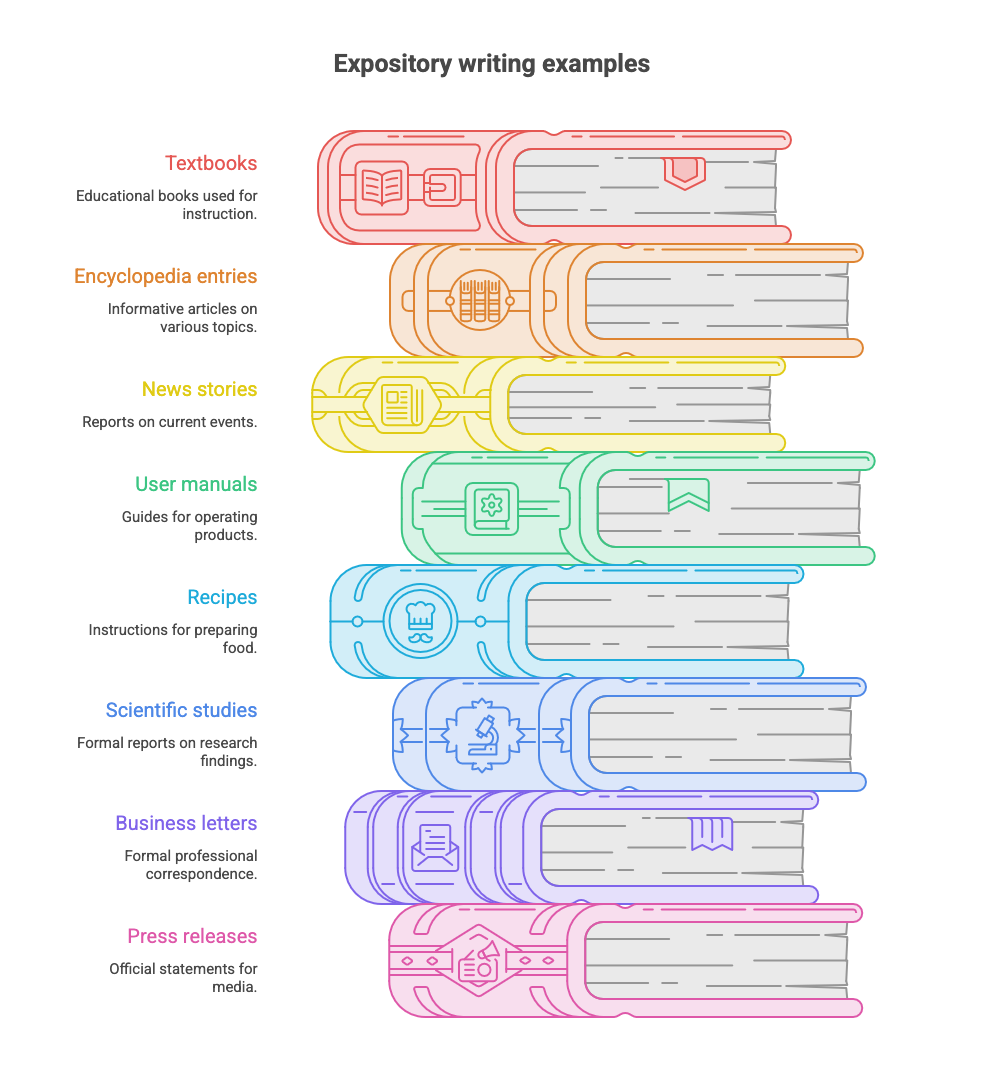
The purpose of expository writing is to explain an event or topic, aiming to inform and educate the reader. Common examples include “textbooks, encyclopedia entries, news stories, how-to instructions (such as user manuals and recipes), scientific studies, business letters, and press releases.”
Expository Writing vs. Other Styles
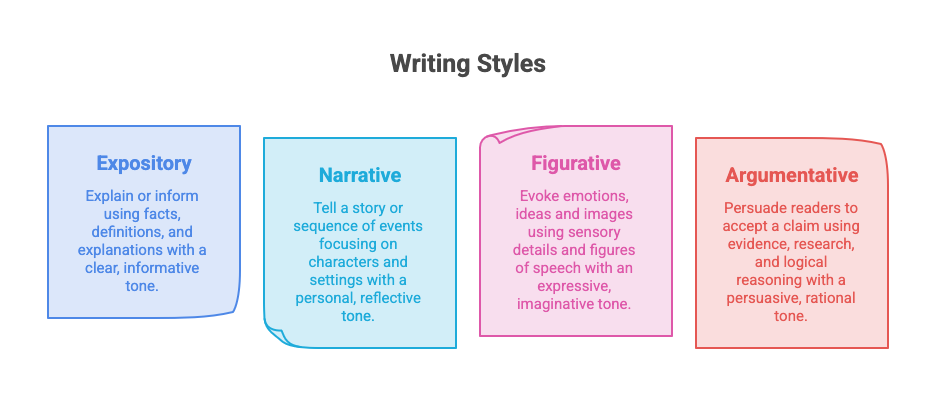
A good way to understand expository writing is to highlight its differences from other styles, such as narrative, figurative, and argumentative writing. Unlike those other styles, expository writing does not primarily express the writer's beliefs, perspectives, or experiences.
7 Types of Expository Writing
Expository writing can take the following forms: definition, process, cause-and-effect, problem-and-solution, comparison, and classification. Each suits a different objective and sets up a different kind of expository structure.
Definition
As you would expect from a dictionary, this kind of exposition gives straightforward descriptions of facts, objects, or concepts.
Examples: Encyclopedia entries, glossaries, textbooks
Process
This style outlines the series of steps needed to complete a task or perform an action.
Examples: User manuals, recipes, how-to guides
Cause-and-Effect
A causal connection is established through cause-and-effect expository writing, which links two related occurrences and systematically describes connections between them.
Examples: Discussing the effect of a tsunami on a coastline, tracking changes in appearance over the course of a workout regimen
Problem-and-Solution
This style presents a problem and then discusses potential solutions that have facts and data supporting their suitability.
Examples: Solving traffic jams through public transit or bikepaths, addressing climate change through different forms of legislation
Comparison
A compare-and-contrast style takes two related ideas or objects and notes similarities and differences between them.
Examples: A pros-cons list, product comparisons, compare-and-contrast essays
Classification
This style of expository writing starts with a broad topic that it breaks down into smaller categories and groupings.
Examples: Biological taxonomies, weather scales for hurricanes, genres of fiction
Sequences and timelines
Sequential exposition delivers a series of linear events, telling a timeline that describes the order things happened in.
Examples: Crime reporting, historical events, lab experiment reports
How to Craft Expository Writing
The focus of expository writing is to present facts clearly and factually, so your writing should be structured to deliver a convincing and coherent reading experience.
Research
Sound expository writing is grounded in specific information from credible sources. Gather facts and data that help to explain or describe your topic and show thorough knowledge of the topic. Be sure to fact-check. Even if your expository paper is about a piece of literature, you will still need to go about collecting facts from within the text so that you can ground your exposition in textual evidence. Take notes and begin organizing subtopics and themes as you research.
Outline
One of the best ways to craft a coherent text is by outlining it first. Since expository writing requires strong factual support, an outline is vital to ordering and keeping track of a high volume of information and sources.
At the outline stage, you can make sure that your document is strongly organized and includes all the necessary facts and details that support its claims. You will also be able to remove extraneous facts and details that don’t contribute toward the focus of your paper.
Be clear and concise
Expository writing is often at its best when it is brief and direct. It’s a forthright and uncomplicated mode of writing that lacks evocative or expressive elements, so it’s important to get to the point quickly without losing the reader’s attention.
Tip: Have a free grammar checker assess your writing for clarity and coherence.
Consider your audience
Voice and tone should be appropriate to the kind of document you’re writing and the kind of reader you’re aiming to inform. You could easily use first-person in a report about your vacation, but referring to “I” in a car user manual would be inappropriate. This blog uses second-person pronouns to address the reader in a natural and friendly tone, but a more neutral and impersonal third-person would better suit an essay about soil erosion under drought conditions.
FAQ
How do you write an expository essay?
An expository essay is also called an “explaining essay,” which aims to explain a topic to a reader so they clearly understand the concept. It requires that a student demonstrate their understanding of a topic, but also their ability to convey information about it accurately and coherently.
The five parts of an expository essay are typically an introduction, three body paragraphs, and a conclusion. This common organizational structure is present in most writing rubrics and will help the reader make sense of your argument.
Is expository writing formal?
For the most part, yes. Some informal features of language like short sentences and contractions are common in expository writing because it makes the writing easier to read and more natural-sounding. Most expository writing, however, will maintain formal language conventions around punctuation and grammar, and will forgo slang, abbreviations, and phrasal verbs.
Is expository writing objective?
No. Expository writing adopts a neutral tone and aims to impart necessary information, but it retains bias. Unlike argumentative writing, which can be transparently biased toward the position adopted in the paper, good expository writing presents a broader set of facts to educate rather than persuade the reader. It is important to note, however, that the author’s perspectives and potential biases are still present. Strong writing often improves its validity by adopting measures to reduce bias.
Can you mix expository writing with other styles?
Yes, certainly! Aside from expository essays, a key element of essay writing is striking the right balance between exposition and other modes like synthesis and argumentation. All essays need to identify, introduce, and explain various sets of facts, which necessitates some amount of expository writing.
In creative writing, you also need to gauge how much expository writing to use, and advice like “show, don’t tell” is aimed at curbing excessive exposition. Although expository writing can quickly deliver information that’s necessary for a reader to follow or contextualize a narrative, too much of it can make a story flat and boring when compared to writing that’s more exciting, such as dialogue, or evocative, such as imagery.